Water management on the farm

The district of Kavrepalanchok in central Nepal is especially dry and one of the first to suffer water stress as the dry season enters its last few months. For farmers, it is essential they manage their water supplies carefully. They need to collect water when it does rain and use it as wisely and efficiently as possible all year round.

We’ve been sent some photo’s from our NGO partners that illustrate how water management techniques are being introduced in our project area, Mandan Deupur. This is an interesting case study in the ‘show don’t tell’ approach to education and training we enable in Nepal.

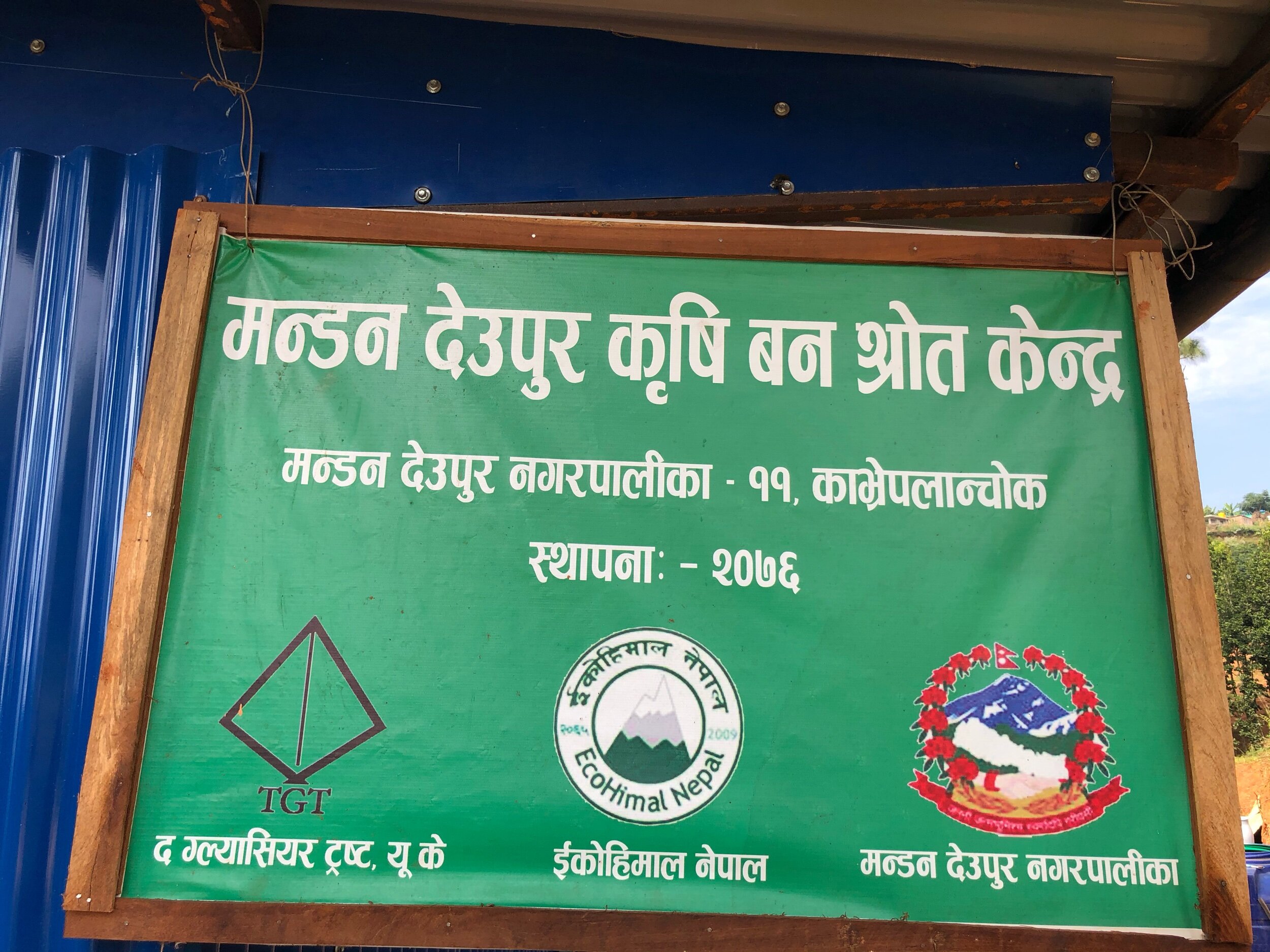
At the newly established Mandan Deupur Agro Forestry Resource Centre (MD AFRC), funded by TGT and the Marr Munning Trust, our NGO partners, Eco Himal Nepal. have been installing a new drip feed irrigation system at the centre’s plant nursery.

DripFeedIrrigation2.jpg

The system is fed by a water storage tank; which is filled just before watering time. Hosepipes are attached to the tank and laid out across the vegetable plot, or bed. The hosepipes are then pierced at precise intervals with a pin or thin nail to create a hole small enough for water to drip out and into the soil. Farmer’s fill the tank with just enough water so that none is wasted. It takes a bit of time to set the system up, but once it is up and running it saves both time and water!

DripFeedIrrigation4.jpg

This irrigation system not only helps the centre to use its own water supply as efficiently as possible, it is also a model of best practice that other farmers can copy and install themselves.

Core to the educational approach of MD AFRC is to ‘show not tell’, in fact it often goes further than that. Local farmers are invited to help with the installation of systems like this so that they can ‘action learn’ by getting hands-on experience of rigging up the bamboo stands, the tanks and the pipework.

DripFeedIrrigation3.jpg

We have secured funding to establish MD AFRC and it is doing well. However, we still urgently need more funds to help it grow and thrive. It will eventually achieve full financial self-sufficiency, but we need to support it through its start-up phase.

To make a donation and to support our project work in Nepal, please visit our donate page.

Before the stoves arrive

If you’ve been following our work over the last few months, you’ll know that we have been busy with our NGO partners EcoHimal Nepal trying to end indoor air pollution for 131 families in Sankhuwashabha (eastern Nepal).

Earlier this month we gave you a quick tour of the factory in Kathmandu where 131 tailor made smoke free cook stoves have been put together ready for transportation to the mountains.

However, this project is not light touch! EcoHimal do not wish to just build stoves and transport them up to two villages and hope that the families there will install and use them correctly. Far from it; we ensure that the stoves are just one part of a project that is wrapped up in education and training on health, climate, women’s empowerment and ecology.

This training effort starts before the stoves arrive. This photo essay features Anisha Kharel and Narayan Dhakhal from EcoHimal and their recent visit to Rukuma and Chepuwa villages in Sankhuwashabha.

First up, here’s Anisha (on the right)! She’s with one of the many children who start their lives in these high mountain environments. It is vulnerable children like this who really help us focus on why our work and this project in particular are im…

First up, here’s Anisha (on the right)! She’s with one of the many children who start their lives in these high mountain environments. It is vulnerable children like this who really help us focus on why our work and this project in particular are important. Climate change is IN NO WAY THEIR FAULT and yet it will impact on their lives significantly.

Here Anisha is welcomed by the community; traditional greetings vary across Nepal, but there is always a welcome.

Here Anisha is welcomed by the community; traditional greetings vary across Nepal, but there is always a welcome.

This is Chepuwa village, it is in the north-eastern corner of Sankhuwashabha, very close to the Tibet border. Thanks to this project, we will end indoor air pollution for every single household in this village!

This is Chepuwa village, it is in the north-eastern corner of Sankhuwashabha, very close to the Tibet border. Thanks to this project, we will end indoor air pollution for every single household in this village!

This is Rukuma village, next door to Chepuwa; we will end indoor air pollution for every single home in this village too!

This is Rukuma village, next door to Chepuwa; we will end indoor air pollution for every single home in this village too!

Training’s like these often happen outdoors, there’s more space, more light and, simply, its nice to be outside! Men and women gathered to listen to Anisha who is telling them about the adverse health and environmental impacts of traditional open he…

Training’s like these often happen outdoors, there’s more space, more light and, simply, its nice to be outside! Men and women gathered to listen to Anisha who is telling them about the adverse health and environmental impacts of traditional open hearth stoves - and why the stoves that will soon be arriving will improve things dramatically. Anisha is describing how deadly indoor air pollution can be. Thankfully the thick smoke they are so used to will come to an end when the new stoves are installed, but Anisha is stressing the danger Carbon Monoxide (CO) still poses if the new stoves aren’t correctly installed and maintained.

The training is not a one-way information transfer exercise; there is plenty of conversation; questions and opinions are answered and discussed.

The training is not a one-way information transfer exercise; there is plenty of conversation; questions and opinions are answered and discussed.

Anisha and Narayan’s visit focused on ending indoor air pollution and the health and social benefits of doing this. They visited to help prepare families for the stoves that will soon be making their way to Chepuwa and Rukuma. This photo helps us im…

Anisha and Narayan’s visit focused on ending indoor air pollution and the health and social benefits of doing this. They visited to help prepare families for the stoves that will soon be making their way to Chepuwa and Rukuma. This photo helps us imagine the ecological benefit the stoves will have too. Deforestation will decrease, more trees and forests (and therefore habitats) will be spared the axe as, thanks to the efficiency of the new stoves, the amount of wood needed to cook and heat homes decreases.

Narayan Dhakhal (in the white scarf) poses for a photo with the men and women whose lives will be changed by this project. For the women especially the benefits will be significant; the amount of smoke inhaled while cooking will reduce to almost zer…

Narayan Dhakhal (in the white scarf) poses for a photo with the men and women whose lives will be changed by this project. For the women especially the benefits will be significant; the amount of smoke inhaled while cooking will reduce to almost zero. They will also have more time on their hands as the amount of wood fuel needed reduces; this is time they can put to another use, studying, leisure, farming, crafting, family time… whatever they choose.


Soon the new stoves will be making their way up to Sankhuwashabha and the training effort will continue. EcoHimal have employed a project officer to work with the community to train them on correct installation and use of the stoves.

Health and safety is a vital concern, the stoves have chimneys that need to put in properly and then looked after. Families also need to be aware of the dangers of Carbon Monoxide and how to prevent it from building up. We will do a follow up story specifically on this soon.

All this work has been made possible thanks to a grant from IFAD to EcoHimal that was matched by those of you who donated to our Crowdfunder campaign in November 2019.

To enable us to do more work on climate change adaptation in Nepal, please consider signing up to donate £3 / month via text.

ChildADAPT.png

Ending indoor air pollution for 131 families

Back in November we launched a Crowdfunder campaign to end indoor air pollution for 131 families in Sankhuwashabha. We were blown away by how many people got involved in pledging support, spreading the word and offering help. 107 people donated a combined total of £10,949 in just 28 days! Many people donated a full £207 to fund an entire stove.

We smashed our original target and got pretty close to our ‘stretch’ target, which meant we were able to fund 42 smoke free cooking stoves to match the 89 already funded by IFAD (The International Fund for Agricultural Development).

This is the first of a series of updates on how the project is now progressing.

Our partner NGO EcoHimal Nepal paid a visit to a factory in Kathmandu in January to take a look at how the stoves are being fabricated. The photo’s below tell their own story, but first up, here is one of the images we used as part of the Crowdfunder - this is Mrs Sujani Gurung, one of the 30 people who took on a stove as part of our pilot project in 2018:

131 of these excellent, tailor made stoves are now very nearly ready to be loaded onto trucks and driven up to the wilds of Sankhuwashabha.

So, as Greg Wallace would say, let’s go inside the factory!

Metal rings that enclose the hot plates for the three hobs

Metal rings that enclose the hot plates for the three hobs

A pyramid of chimney’s - the most important feature of the stove; smoke filled kitchens will soon be a thing of the past in Chepuwa and Rukuma villages, Sankhuwashabha

A pyramid of chimney’s - the most important feature of the stove; smoke filled kitchens will soon be a thing of the past in Chepuwa and Rukuma villages, Sankhuwashabha

Conical chimney hoods that keep the rain out of the chimney; not to mention the many curious animals that live in Nepal’s mountains.

Conical chimney hoods that keep the rain out of the chimney; not to mention the many curious animals that live in Nepal’s mountains.

A look inside the stove before the hot plate and chimney are attached; you can see the roof of the oven chamber.

A look inside the stove before the hot plate and chimney are attached; you can see the roof of the oven chamber.

In the red coat is Narayan Dhakhal from EcoHimal, he’s checking the door to the oven opens and closes smoothly.

In the red coat is Narayan Dhakhal from EcoHimal, he’s checking the door to the oven opens and closes smoothly.

The stoves are designed to be robust, but also manoeuvrable, whilst trucks and tractor trailers carry the load for most of the journey from Kathmandu to Sankhuwashabha, the last few miles up to the villages can only be reached by foot, so the stoves…

The stoves are designed to be robust, but also manoeuvrable, whilst trucks and tractor trailers carry the load for most of the journey from Kathmandu to Sankhuwashabha, the last few miles up to the villages can only be reached by foot, so the stoves need to be light enough to be carried.

Here are some almost complete stoves. In this photo, you can see the door to the furnace section; users need to keep this door shut to maximise wood burning efficiency. You can also see the three hobs and the base of the chimney.

Here are some almost complete stoves. In this photo, you can see the door to the furnace section; users need to keep this door shut to maximise wood burning efficiency. You can also see the three hobs and the base of the chimney.

Stacked and ready to be loaded onto to lorries for transportation to the mountains of eastern Nepal.

Stacked and ready to be loaded onto to lorries for transportation to the mountains of eastern Nepal.

Diary entry 6

Morgan is now in Nawalparasi with colleagues from our partner NGO HICODEF. In his sixth diary entry he reflects on their visit to the field to mark the launch of our new project Layer Farming for Adaptation.

Monday 21st

Early start to fly down to Bharatpur airport for a transfer to HICODEF’s offices in Kawasoti, Nawalparasi. It is noticeably hotter and more humid down here on the Terai. 

IMG_4710.jpeg

I was welcomed by Surbir Sthapit and Shukra Raj Ojha who has just been appointed as Programme Coordinator for our newest project Layer Farming for Adaptation. We spent the rest of the morning reviewing the three year ECCLA (Enhancing Community Capacities for Learning and Adaptation to Climate Change) programme that wrapped up in July. ECCLA has made several positive impacts in the three target villages.

Climate resilient vegetable production has made huge progress, with over 20% of farmers now able to sell commercially in local markets for the first time. This is thanks to dedicated training, resource provision and the work HICODEF has done to create a route to market for the farmers. 

Just before lunch we went through the plans for Layer Farming for Adaptation which will take us to the remote villages at the top of Siwalik hills in eastern Nawalparasi. We’re forecasting five years on this project, focussing on three villages in the first phase between now and summer 2021.

Layer farming is the practice of intercropping several crops that grow to different heights in a symbiotic way. Tall trees provide shade for lower bushes, which in turn protect root vegetables or pulses.

Adjustments.jpeg

After lunch we travelled by jeep up to one of the LFA villages, Repaha to meet the local farmers group and to learn more about the coffee trees that are growing here. The coffee was planted around ten years ago, following a donation of seeds by an NGO. It grows well, but the farmers have no way of getting it to market. It therefore remains largely unkempt and when it fruits in January, cherries are either left on the tree or picked by children who eat them like sweets. Some farmers do pick a few kilos, the ones who like to drink coffee. They leave it to dry out (without removing the fruity layer) and then, when they fancy some coffee, remove the husk and roast over an open fire. 

We found that some farmers already have an enthusiasm to commercialise their coffee - which is great news for the LFA project. Several have started their own nursery plots to grow coffee for transplanting later. They’re hopeful HICODEF and TGT can enable them to process the coffee to parchment stage and organise a route to market so that they can start selling and earning.

IMG_4366.jpeg

Like in Solukhumbu, investing in layer farming as a climate change adaptation strategy makes sense here. The trees provide shade, helping to keep things cool in the summer months. The income they can potentially generate will help too, they’ll have more money to invest in complementary adaptation strategies like water harvesting, polytunnels and insect pest control.

Layer farming also has a climate change mitigation effect; more trees equals more carbon sequestration. 

Wednesday 23rd

After spending the night at HICODEF’s staff lodging’s in Kawasoti, we went by jeep again to the second village we’ll be working in for the LFA project. Lahape is at the end of a long, winding and bumpy dirt track at an altitude of 1,300m. 

The journey took 4 hours and we passed several jeeps carrying 15 or more passengers. This is the public transport system round here, it costs around 300 rupee for a place on the jeep - same price whether you’re inside or on the roof! 

IMG_4377.jpeg

From Lahape, when the clouds part, you get a spectacular view of the snowy Annapurna range, but the local landscape is dramatic in its own right; high forested slopes, terraces, long sheer drops and traditional houses complete with thatched roofs and mud walls.

IMG_4421.jpeg

Like in Rapaha, coffee is growing all over this village. But we have heard the same story, there is no route to market. With HICODEF’s local connections to some very energetic cooperatives and the knowledge  and contacts TGT is developing through our projects with Eco Himal, we can hopefully enable farmers to solve this problem. 

Similar to Rapaha, farmers here are very keen to make the most of their coffee. Hundreds of trees exist here already, many more have been planted in nurseries. One farmer told us that he plans to plant 10,000 coffee trees. I hope he is not trying to run before he can walk. 

Training on how to process the coffee to create a high quality product is essential. HICODEF have lined up an expert trainer (who has also trained farmers in Solukhumbu) to come here in January. We expect the training to be oversubscribed. 

IMG_4591.jpeg

The training and January’s harvest should produce a healthy sized sample of parchment that we can take to Kathmandu for roasting and tasting. If the quality is good (and judging by the hand roasted cups we drank this morning it should be), eastern Nawalparasi could very quickly become a new coffee zone in Nepal. 

If it does, we will have a brilliant climate change adaptation and sustainable development story on our hands.

Diary entry 5

Our Co-Director, Morgan, had a short stop off in Kathmandu before heading down to Nawalparasi, here’s his fifth diary entry:

Sunday 20th

My Co-Director, Richard, and I visited Prof Rejina Maskey at Tribhuvan University this morning to reflect on the 2019 higher education programme and plan for 2020. We agreed on a slight tweak. From this year on, we’ll be providing two dissertation scholarships of 50,000 Nepali Rupee (approx. £320) to assist the two Tribhuvan students who act as research assistants and translators for the U.K. students who travel to Nepal each summer. 

93a9a35a-5427-46f2-b280-516f2e46685a.jpeg

Masters students at Tribhuvan take a two year course, rather than the one year programme that is typical in the U.K. Tribhuvan select two first year students to partner with the UK students and base the selection on them having shared research interests. For the Tribhuvan students, the research trip with their U.K. partners is a chance to do some preliminary field study and formulate their research questions. 

The field experience they gain, including the joint learning with their U.K. partners, sets them up for their own dissertation research, which they conduct a year later. It is this dissertation work that our new scholarship will contribute towards. This is all part of our effort to develop the next generation of climate change adaptation professionals. 

Diary entry 4

Morgan is back in Kathmandu now. This is his fourth diary entry from his time monitoring projects in Solukhumbu and Kavre.

Saturday 19th October

Our last monitoring task in Deusa was a visit to the Hazelnut plantation, which was planted two years ago a few kilometres north of the AFRC, at an altitude of around 2,000m. The trees are in the dormant phase of their annual cycle and making reasonably good progress. Some plants are doing better than others, there was some evidence of insect pests, including the giant hairy caterpillar we met! 

IMG_4223.jpeg

The Hazelnut trees need to be tended as they develop, they are not yet old enough to fruit, it may be another two years. Keshab (AFRC manager) explained that, due to a lack of time, the farmer whose land the hazelnuts are on hasn’t been clearing the weeds around the tree enough. This needs to happen to ensure nutrients aren’t being diverted away from the trees. We’ll need to work out a way to support him in doing this, many hands make light work. 

IMG_4258.jpeg

It’s Saturday morning now and I’m sat with the team at our brand new AFRC in Mandan Deupur, Kavrepalanchok. Our NGO partner, Eco Himal Nepal, have been working here for three years, mostly on education and sexual health projects. Together, last year, we secured three years of funding from Marr Munning Trust, to establish a new Agro Forestry Resource Centre here, along similar lines to Deusa AFRC. 

IMG_4249.jpeg

In June the AFRC building was completed and we slept here last night ahead of meetings today with the new committee and a tour of the progress made so far. I’ll report on what I learn in my next entry.

Diary entry 3

Our UK co-Director, Morgan Phillips, is in Nepal to monitor our project work. Here is his third diary entry.

Thursday 17th October

The nine students and two teachers from GSIS school, trekked out of Deusa this morning after spending four nights with us. It was great to spend time with them and observe how their understanding and appreciation of life here grew over the week. 

IMG_3966.jpeg

They have a day in Kathmandu before they head back to Hong Kong and it was really lovely to listen to their ideas on how they plan to raise funds for our work here.

Since my last entry we’ve visited Aranjit Rai and his family on their farm just below Deusa Secondary School. Aranjit told us how he’d witnessed the climate changing in Deusa over the last few decades and how it was forcing him into a process of continuous adaptation as new challenges relating to water supply and insect pests kept appearing.

IMG_4343.png

We met his son Dilli Rai too, he has recently returned from working in South Korea and over the last few months has benefited from the resources, support and advice being provided here by our partner NGOs. 

We spent the afternoon learning and playing with children from Deusa Secondary; after some initial shyness the students all started to bond through the shared language of music, dance, volleyball and football!

IMG_4054.jpeg

On Wednesday, we trekked down to Amar Rai’s farm on the eastern side of Deusa. I’ve met Amar before, he is an innovator and one of Deusa’s ‘lead’ farmers - a role model for his neighbours. His plant nursery is extraordinary, though not without its challenges. Like many farmers here, his citrus fruits are infected with fruit fly larvae.

IMG_4090.jpeg

This is one of the ways climate change is causing havoc for farmers. On the recommendation of the AFRC, he hangs traps in his orange trees that attract flies at night. Amar says this hasn’t solved the problem, but has made it more manageable. More farmers need this advice and these traps.

Diary entry 2

UK Co-Director, Morgan Phillips, is in Nepal at the moment monitoring our project work in Solukhumbu, Kavre and Nawalparasi. This is his second diary entry.

The students from GSIS school arrived safely here in Deusa yesterday and have settled in brilliantly.

It was a full moon last night, the one that marks the end of the Dashain festival and the last day for giving and receiving Tika. Village elder, Gulkrishna Rai, the founder chairperson of Deusa AFRC led a Tika ceremony for us all - a truly special moment.

public.jpeg

During the afternoon we toured the grounds of the AFRC. It is noticeably more mature compared to my last visit, Keshab Rai and Hari Kumar Kharki are concentrating on tree grafting at the moment. This involves grafting high yield varieties of fruit trees onto the roots of their local equivalents. 

Over time, as grafted trees mature, the productivity of apple, oranges and lemon trees will improve significantly. They are also taking care to choose varieties that are more resilient to the impacts of climate change. 

As part of the Prime Minister’s agricultural modernisation programme the AFRC was selected to receive a high tech polytunnel. It is possible to monitor and maintain constant temperature in the polytunnel and it has an automatic watering system. This is making it easier to grow seedlings for sale and grafting. 

public.jpeg

Today we trekked down to the village of Kurte, it was the first time I’d ever been there, it is beautiful. We had tea in the new community hall before a training session on biointensive tree planting, which is a fascinating process to give the tree the maximum chance to thrive.

public.jpeg

There is now a Macadamia tree growing in Kurte that should start fruiting in 2023. 

public.jpeg

After a beautiful farewell programme in Kurte and a tough climb back to the AFRC, we had dinner before Anisha from EcoHimal led a really engaging reflection session with the students. They are starting to ask deeper questions about the things they are learning and experiencing.