More important things

More important things

by Richard Allen in Kathmandu


It is one more stark example of the differences of the haves and have nots. The British press of all shades have been endlessly headlining, for months and months, the possibilities of when the British public will be permitted to go on holiday and where to, and the necessity for testing, quarantine, lock-ins on their return from an overseas holiday.  One of the worst examples of the British fake news spreaders recently headlined the fact that the Nepali variant (currently unproven and non-existent) is a threat to their holidays – and, oh horrors, Portugal has just moved from green to amber.

To me, a Brit living and working in Nepal, which is, as most will know, having a very tough time with COVID, this focus on when and where we can go on holiday, is astonishing. In comparison with so many countries in the world, the UK is so so comfortable, so much of that comfort still deriving from the long gone hundreds of years during which Britannia once ‘ruled the waves’.

Here in Nepal, the great majority of the population don’t have the resources or time to go on holiday – the great majority are farmers who have crops and animals to care for every day of the year. Nepal is not alone, we read too much of the wars and troubles in too many countries to list here. 

And now the Covid virus. But when nations of the world need to come together, realise at a fundamental level that we are all in this together, that it is not going away, and that the only way we can control the spread is to cooperate, scrap ideas of borders, and separateness……the worst elements of the British press nominate countries to blame and invent non-existent variants.

Added to the decision to reduce the overseas aid budget by £4 billion, which led to our NGO having to apologize to our Nepali partners who had wasted well over 100 hours on preparing a proposal for UK Aid for an enlightened agroforestry programme down the hills from Everest, the Brits in Nepal have now been further embarrassed by the naming and shaming of this wonderful country on the front pages of our little island newspapers.

Is there no empathy and compassion left? Is it all about separation nowadays? Are we all existing in our own little spaces, territories, countries within our own little blinkered support groups? No, it is not all about this, there are hundreds of examples of countries, peoples, trans national groups working together for the betterment of humanity, the environment and the world – but this Covid virus has certainly shone a light on the failure of world and national leadership to put politics aside and be able to work together in the time of a worldwide crisis. And it is not as if we do not have a few other crises bubbling up across the world!

It appears as if most world leaders are not plugged into the spirit of humanity. I saw the G7 described as the “leading” nations, then the “advanced” nations – what does the G stand for…… global – really?....... they are certainly advanced in galling, garrulous, gold-digging, greed, grating….. and refusing freedom from patents…..after all, we could be making our own vaccinations in Nepal.

If the seven of them, or 20 of them, whatever, need an example of focused energy, discipline and compassion, in relation to this Covid pandemic, please take a look at Bhutan and New Zealand.

Only two things can control this virus – a permanent lockdown, or vaccinating > 75% of the world population – the former is unrealistic, and we are very far from the latter.

Vaccines please, leaders – scientists in many different countries have done such an amazing job in developing these vaccines, please don’t screw it up with hoarding, allowing vaccines to expire, self-serving press conferences, unnecessary expenditure on flat and press room renovations - please leave your competitive personalities at the Olympics and on the football fields.  In fact, come to think of it, so much money is wasted on the never ending arms race, wars, conflicts, controlling of populations…., that maybe a short holiday for the wealthy is the least of our worries.  But, my God, it is annoying to see it on the front pages.

Many of us have seen friends, acquaintances, and people we know suffer or die during this pandemic. Can we not leave behind the baggage of fear, envy and resentment, and put judgements aside for this year? Can we instead be gentle and patient, and live the words “for the common good”, rather than just speak them.

Well, I am sending this over to the UK now, and I will get back to lockdown, Kathmandu style – wondering where the next bucks are coming from (haven’t earned a bean since June last year), but its fasting week with my daughter, and I’ll continue with my meditation course, reading and gardening….. sure, I would love to go on holiday, and I am one of the lucky ones that can afford it, but right now, dear Brits, dear editors, dear leaders, there are more important things.

Should all philanthropists be climate philanthropists?

We have recently been in touch with Germany based organisation ‘Active Philanthropy’ who have published a fascinating new report to make the case for more investment by philanthropic bodies into climate change.

FundingFuture.png

Their new report, ‘Funding the Future - how the climate crisis intersects with you giving’, is aimed at foundations, trusts and individual givers who have not previously engaged with climate change.

The key point is that the forthcoming climate catastrophe will have an all-consuming impact on the multiple other causes we all care about. It’s something our work in Nepal makes us acutely aware of.

The steady progress that has been made over the last few decades - especially in hill communities - to improve health, education, women’s empowerment, the economy, democracy and so on could be swept away in one generation if climate chaos descends.

Indeed, if communities weren’t being enabled to adapt to the changes they are already experiencing, some of this progress might already have stopped or gone into reverse.

To put it even more bluntly, while programmes to improve health, education, gender equality and employment opportunities in remote mountain villages are hugely important; climate breakdown might render them meaningless if those villages end up being abandoned.

If you know, or work with any foundations or trusts who are considering a move into funding climate change; please encourage them to read the report. It can be downloaded via the Active Philanthropy website.

Active Philanthropy are launching their report with an online event on 20th October. You can find more details here: https://www.activephilanthropy.org/what-we-do/climate-guide/2020-10-20

Glacial lakes are growing at an extraordinary speed

On Monday, in the journal Nature, a team of scientists, led by Dr. Dan H Shugar published a paper mapping the glacial lakes of the world.

Their findings are extraordinary. Between 1990 and 2018, the physical number of glacial lakes has increased from 9,400 to 14,300 (a 53% increase) and the total global volume of glacial lake water has increased to an estimated 156.5 km3 (a 51% increase).

Glacial lakes have formed and expanded at the fastest rates in the highest of high altitude regions. The Himalayas, and therefore Nepal, is the epicentre.

For the work we enable in Nepal, there are two major implications:

  1. Glacial Lake Outburst Flood: Each glacial lakes is held back by a stone, earth and ice formation called a Morraine. The Morraine acts like a dam, but many are fragile. They can collapse if one, or all of three things happen: (a) the ground ice that holds them together thaws; (b) if the volume of water they are holding back gets too large; or (c) if a large avalanche of snow or rock falling into the lake from the mountain above causes a tidal wave that overtops and destroys the morraine. Any of these things can cause a Glacial Lake Outburst Flood (GLOF) that sends water and rock hurtling down the mountainside and valley below.

  2. Ending the supply of fresh water: GLOFs can cause immense damage to houses, farmland, bridges and roads and can of course kill the people, plants and animals in its path. But there is also a longer term problem, before any GLOF happens, water from glacial lakes seeps through its Morraine and graudally feeds the streams and rivers below. If the glacial lakes disappear, this year round supply of fresh water - that in some cases hundreds of thousands of people are reliant on - goes with it.

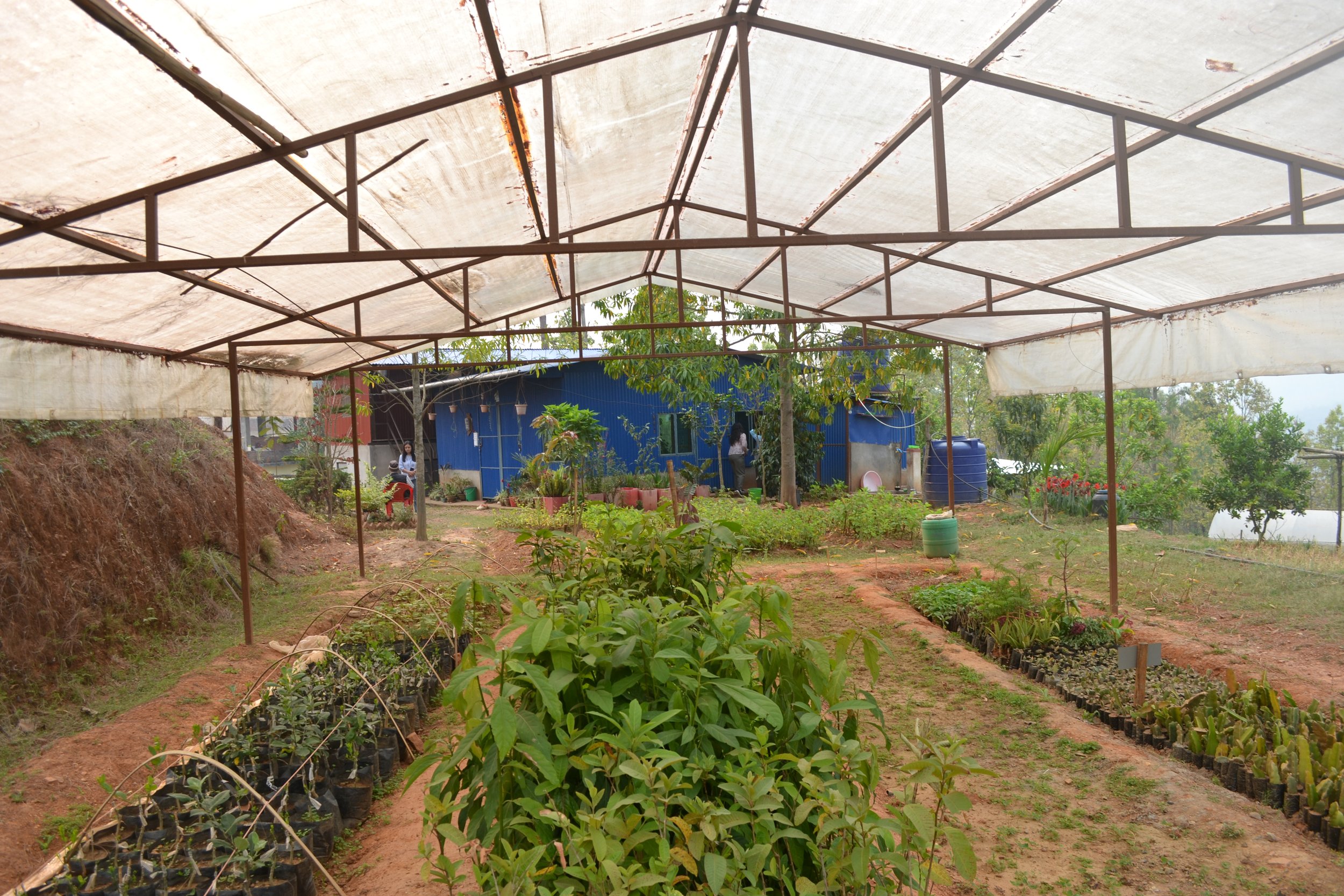
In the high mountains, above our project areas of Deusa and Waku in Solukhumbu, we know of a newly formed glacial lake, West Chamlang lake [which until recently was only known as Lake 464], that is in the shadow of the giant Mount Chamlang.

We want to send an expedition to West Chamlang lake

Mount Chamlang is just east of Mount Everest and yet has hardly ever been visited. Scientists who have been there to do preliminary studies of West Chamlang lake are concerned by the speed at which it has grown; they have called it a ‘ticking time bomb’. It seems to be a matter when, not if, a GLOF will occur.

A GLOF event at Chamlang would be a catastrophe for the farmers who live in the valleys below. More research into the size of the lake is desperately needed. Very little is known about its depth and therefore volume; we don’t know how fast it is growing. We don’t know how stable the snow and ice on the 2,000 metre high cliff that hangs above it is; and we don’t know how stable the Morraine that holds the lake back is.

A mapping exercise also needs to be done to ascertain how many people, plants and animals are at risk in the valleys below and a plan needs to be developed to work out how best to mitigate the risks.

This research is not easy, not without risk, and not cheap. These, however, are the expeditions of the 21st Century and we hope that those with deep pockets can be motivated to fund them.

Climate change is changing the world and we need to understand how, so that we can take action to save lives, both in the short and long term.

The Glacier Trust is ready to partner with anyone interested in a research expedition to West Chamlang lake. We have the local connections to the indigenous people who live below it and links to the major institutes in Nepal to pull a research team together.

If you want to know more, or are interested in supporting this work, please get in touch.

Framing Adaptation

In our latest report, ‘Framing Adaptation’ [PDF download], we explore how five of the largest UK environmental organisations are contributing to the adaptation narratives that we see gaining traction.

CarysFB.png

Including a foreword from Dr. Antje Brown (University of St Andrews), this report summarises undergraduate dissertation research conducted by TGT volunteer Carys Richards.

Framing Adaptation builds on our ‘We Need to Talk About Adaptation’ research, which examines the media coverage of adaptation by Greenpeace, Friends of the Earth, RSPB, The Green Party of England and Wales, and WWF UK. Our previous research found that these organisations are largely silent on adaptation.

‘Framing Adaptation’ seeks to untangle how environmental organisations are framing adaptation and the adaptation narratives they contribute to. Frames and narratives are powerful because they are easily normalised and often left unchallenged.

We reviewed 2,534 articles in total from a period between March 2017 to December 2019. There were only 19 adaptation-focused articles that we could examine.

The frames explored are:

  1. the ‘mitigation’ frame

  2. the ‘security’ frame

  3. the ‘techno-scientific’ frame

  4. the ‘ecological’ frame

The report summarises what these frames are, and the potential implications of each. Our findings suggest that organisations are moving away from the positioning of adaptation as the poor cousin to mitigation, and are no longer viewing adaptation as just a technological solution to the impacts of climate change. The most common frame used was to present adaptation as a security issue.

The Glacier Trust urges UK environmental organisations, journalists and campaigners to contribute to the adaptation narrative and consider carefully how they frame these contributions.

We still need to talk about adaptation, and when we do- let’s consciously frame it. Let’s actively drive the conversation.

Sacred Mountains

Just over a month ago artist Tom Hunter got in touch with us via Instagram. He was letting us know that he was exhibiting and selling paintings from his Sacred Mountains collection at the Peloton Espresso coffee shop on Cowley Street, Oxford, UK.

Very generously he is donating £20 from the sale of the originals and £2 from the sale of every print to The Glacier Trust. Here’s what Tom had to say about his work and his connection to the work we do:

As well as draw and paint I also teach Art at Magdalen College School, here in Oxford. Mountains have become a large part of my practice and I have spent the last few years experimenting with various concepts based around them. I have become increasingly aware of the changes in mountain environments due to global warming and have great respect for the work you are doing with people that have relied on weather patterns and conditions in the mountains for hundreds if not thousands of years. It is devastating to think that these are the communities that will perhaps feel the worst impact of western fossil-fuel use. Well done on the fantastic work you are doing and please let me know if there might be any other way I could help out.

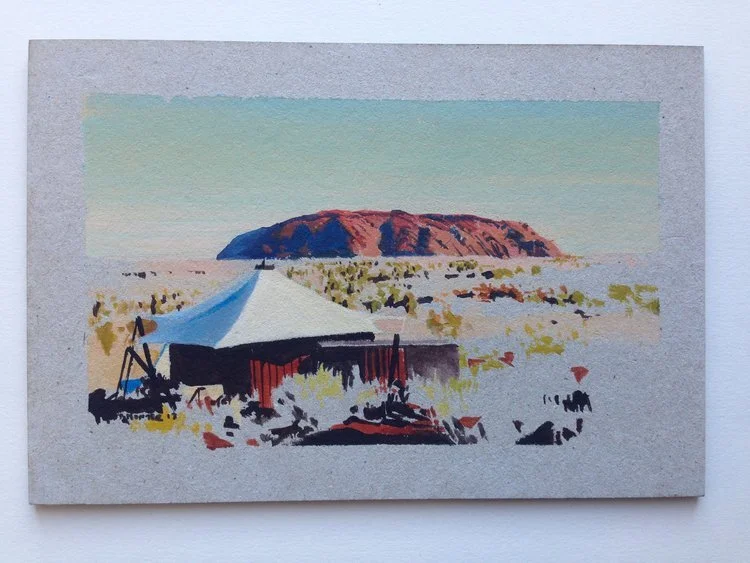
The Sacred Mountains in the collection are from all over the world. Mont Ventoux (France) is sure to go down well with the cyclists at the Peloton Espresso; also features are Mount Kailash (China), Uluru (Australia) and Navajo Mountain (USA).

Uluru, by Tom Hunter, Sacred Mountains

Uluru, by Tom Hunter, Sacred Mountains

Mount Kailash by Tom Hunter, Sacred Mountains

Mount Kailash by Tom Hunter, Sacred Mountains

Navajo Mountain by Tom Hunter, Sacred Mountains

Navajo Mountain by Tom Hunter, Sacred Mountains

About the exhibition:

A series of postcard-sized paintings created following a virtual pilgrimage of Sacred Mountains from around the world. Irrespective of nationality, belief or era, humans have held certain mountains in such high-regard as to declare them sacred. This labelling has been founded on various elements, from physical reliance such as the source of fresh water to spiritual belief and their proximity to the deities. As we become increasingly aware of glacial melt due to global warming, the mountains have become a litmus for our precarious situation and now more than ever, are worthy of our close attention.


For more information about Tom Hunter and to view the full Sacred Mountains collection please visit therealtomhunter.co.uk

Visit the Sacred Mountains collection at:
Espresso Peloton
 76 Cowley Road
Oxford
OX4 1JB 

Why do we wait for disaster before we help?

IMG_6777.jpeg

One third of Bangladesh is being impacted by the flooding going on there; over 2 million people have been directly impacted. The same monsoon season is taking a terrible toll in India and Nepal; 550 lives have been lost so far, with hundreds more people missing.

This news, of course, should motivate us to double (probably quadruple) our climate change mitigation efforts, but more immediately we need to equip people with the early warning systems and basic infrastructure that can save lives that would otherwise be lost the next time floods and landslides hit (and they will hit).

Here’s a quote (via the guardian) from the UN under-secretary-general for humanitarian affairs and emergency relief coordinator, Mark Lowcock:

“If we know a flood is about to hit, why wouldn’t we give river communities the means to get themselves, their livestock and their tools out of harm’s way before the deluge comes, instead of waiting until they’ve lost everything, then try and help?”

He’s dead right.

#WeNeedToTalkAboutAdaptation

Why I am fundraising for The Glacier Trust

IMG_6674.jpeg

ESSAY IN SHORT(ISH) LETTER FORM TITLE:
WHY I AM FUNDRAISING ON/FOR MY BIRTHDAY FOR THE GLACIER TRUST

by Arthur McManus

One almost instantly noticeable difference for many people from the continuing global upheaval that Covid-19 has caused is the number of clear skies over cities as pollution levels drop, possibly somewhere near you.

Many people have seen online the pictures of the Himalayas, visible from more than 100 miles away in parts of India for the first time in young people’s memories.

And indeed, the International Energy Agency is expecting global industrial greenhouse gases to be about 8 percent lower in 2020 than the previous year.

But the cold Covid reality is that even if we abandon our planes, trains and cars, we are still not "decarbonising" enough to meet the Paris Agreement goals.

If we are to reluctantly accept our post climate change world, we need to adapt, and some need to do that much more quickly than others.

Unfortunately, according to the Climate Policy Initiative, whilst a huge $537 billion was spent on climate change MITIGATION in 2017-18, only $30 billion was invested in ADAPTATION.

Furthermore, in 2016 the UN Environment Programme suggested that adaptation would cost at least $140 billion and possibly up to $300 billion annually by 2030.

It would seem hopeless EXCEPT for one huge hidden bonus: those large figures we have to put aside for adaptation can be outweighed by the huge benefits that they would bring – it is estimated that $1.8 trillion worth of investments between now and 2030 could generate $7.1 trillion in net benefits.

In an ocean of sinking ships, some ships sink faster. The need for adaptation is already very real for people living on the margins of climate change. Which brings me back to those Himalayas. Even within a country like Nepal, varied topography means climate and weather effects are very localized. That’s why The Glacier Trust is helping the most vulnerable upland communities to adapt now, and why we dearly hope you would consider investing in them and their children’s future.

If you have the time, please visit our fundraising page and take the opportunity to visit The Glacier Trust website, I promise your valuable time (and hopefully money!) won’t be wasted. (And BTW I did mention that it was my birthday, didn’t I?!).

Love, Arthur and baby Hallam xxx

NEW REPORT: Barriers to coffee farming

The aim of our Higher Education programme is to help nurture the next generation of climate change adaptation professionals.

In June 2019, Charlotte Thomas an MSc Student from University of Southampton travelled to Nepal to spend time at Deusa Agro Forestry Resource Centre. Along with a fellow Southampton student and two students from Tribhuvan University, Charlotte researched elements of the work we are enabling in Nepal.

Her dissertation has been very useful to the ongoing design and delivery of our project work with EcoHimal Nepal. Charlotte has produced a report based on her dissertation to summarise her findings. It is the first such report we have published.

The findings are very important and must be into consideration by TGT and our partners as we design and deliver adaptation work in Nepal. Our UK Co-Director, Dr. Morgan Phillips has written a foreword. We quote from it here:

Climate change adaptation is part of the sustainable development process in Nepal. In the village of Deusa, where a ground-breaking Agro Forestry Resource Centre has been established, development has been rapid for many families over the last decade. Inevitably, this has had a disrupting impact for some.

Charlotte has identified the factors that prevent some female members of the community from benefiting from the recent move towards coffee production. If this is not addressed, inequalities may begin to widen.

The insights this report gives us, will enable us to ensure that project work takes gender equality issues into consideration as agroforestry scales in the region.